FBAR vs FATCA Form 8938: Key Differences Every Filer Should Know
Matt Cohen, CPA ·
FBAR Direct prepares and files your FBAR (FinCEN Form 114) on your behalf. You are responsible for reviewing all information for accuracy before submission to FinCEN. This article is for informational purposes only and does not constitute tax, legal, or financial advice.
FBAR Direct prepares and files your FBAR (FinCEN Form 114) on your behalf. You are responsible for reviewing all information for accuracy before submission to FinCEN. This article is for informational purposes only and does not constitute tax, legal, or financial advice.
FBAR vs FATCA Form 8938: Key Differences Every Filer Should Know
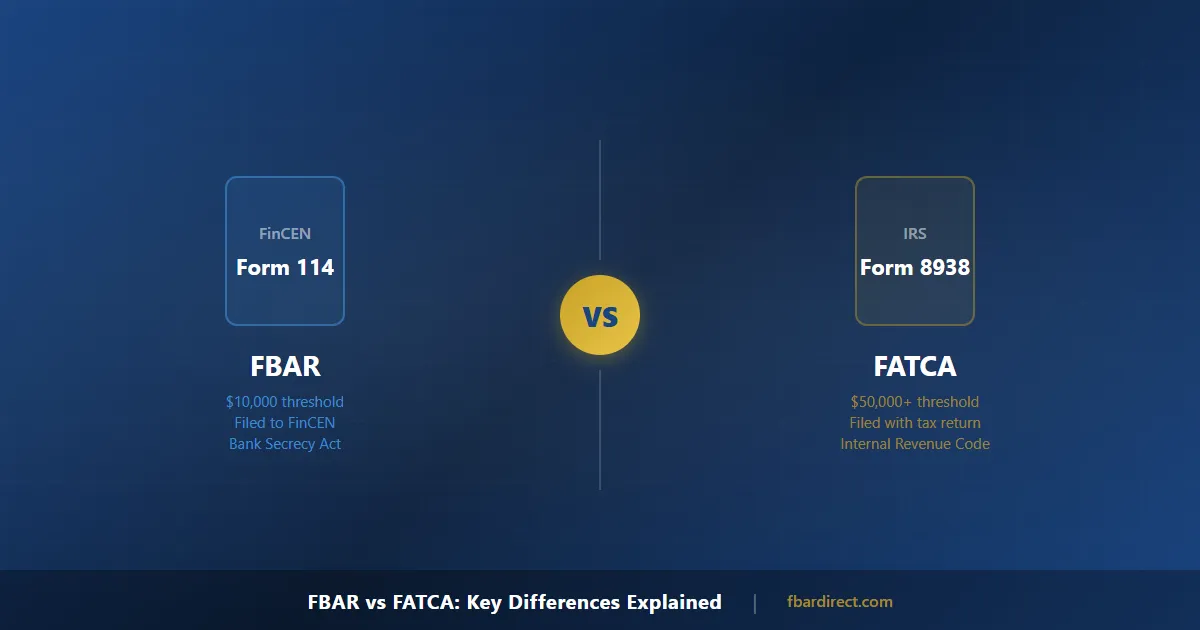
US taxpayers with foreign financial assets often face two overlapping obligations: the FBAR and Form 8938. Both require disclosure of foreign accounts and foreign assets, but the FBAR and Form 8938 go to different agencies, cover different financial accounts, and carry separate penalties. The key differences between the FBAR vs FATCA Form 8938 affect who files, what you report, and what penalties apply.
The FBAR (Report of Foreign Bank and Financial Accounts, FBAR FinCEN Form 114) falls under the Bank Secrecy Act. The Financial Crimes Enforcement Network (FinCEN) administers it. Form 8938 — the Statement of Specified Foreign Financial Assets — falls under the Foreign Account Tax Compliance Act (FATCA). Filing one does not satisfy the other: you must file the FBAR under 31 USC 5314 and Form 8938 under IRC 6038D if both thresholds are met for the tax year.
What Is the FBAR vs FATCA Form 8938 Difference?
The FBAR and Form 8938 are separate foreign asset reporting obligations. The FBAR goes to FinCEN and covers foreign bank and financial accounts exceeding $10,000 in aggregate value under 31 CFR 1010.306. Form 8938 goes to the IRS with your income tax return and covers specified foreign financial assets above $50,000 under 26 USC 6038D. Each applies its own reporting threshold, deadline, and penalties.
Who Must File the FBAR and Form 8938?
Per IRS and FinCEN rules, both the FBAR and Form 8938 apply to US persons, but the filer pools differ. The FBAR applies to any US person with a financial interest in or signature authority over foreign financial accounts. Form 8938 applies only to those who file a federal income tax return per IRC 6038D. No tax return filed for a given tax year means no Form 8938 obligation.
FBAR Filing Rules
Under 31 CFR 1010.350(b), a "United States person" includes US citizens, green card holders, resident aliens, and domestic entities (corporations, partnerships, LLCs, trusts). The FBAR captures anyone with a financial interest in or signature authority over foreign financial accounts — even if accounts produce no income. See FBAR filing for green card holders.
Form 8938 Filing Rules
Form 8938 applies to US citizens, resident aliens, and nonresident aliens who elect to file jointly with a US spouse, per IRC § 6038D. Form 8938 is filed as an attachment to the taxpayer's annual tax return. The IRS instructions for Form 8938 detail which specified foreign financial assets to report.
What Are Specified Domestic Entities?
Specified domestic entities also have a Form 8938 obligation. Certain domestic entities formed or used to hold foreign financial assets must file Form 8938 under IRC 6038D(f). These specified domestic entities include domestic corporations, partnerships, and trusts — for example, domestic entities with at least 50% foreign assets. The IRS targets specified domestic entities to prevent hiding foreign assets inside domestic entities.
What Are the Reporting Thresholds for the FBAR and Form 8938?
The reporting threshold for the FBAR is a flat $10,000. The reporting threshold for Form 8938 varies by filing status and residence. Many taxpayers file the FBAR but not Form 8938, while those with higher foreign assets file both the FBAR and Form 8938.
FBAR Reporting Threshold
Under 31 CFR 1010.306, the FBAR reporting threshold is $10,000. If the combined account balance of your foreign financial accounts exceeds $10,000 at any point during the year, you file the FBAR (FinCEN Form 114). Single, married filing jointly, or married filing separately — all use the same $10,000 threshold. See how to calculate maximum account value.
Form 8938 Thresholds for Domestic Filers
For US persons living in the United States, Form 8938 thresholds under 26 USC 6038D(a) are:
- Single or married filing separately: File Form 8938 if the total value of specified foreign financial assets exceeds $50,000 on the last day of the tax year, or exceeds $75,000 at any time.
- Married filing jointly: File Form 8938 if the total value exceeds $100,000 on the last day of the tax year, or exceeds $150,000 at any time.
Form 8938 Thresholds for Filers Living Abroad
For US persons living outside the United States, Form 8938 thresholds are higher:
- Single or married filing separately: File Form 8938 if specified foreign financial assets exceed $200,000 on the last day of the tax year, or exceed $300,000 at any time.
- Married filing jointly: File Form 8938 if specified foreign financial assets exceed $400,000 on the last day of the tax year, or exceed $600,000 at any time.
What Foreign Financial Assets Does Each Form Cover?
The FBAR and Form 8938 cover overlapping but distinct categories of foreign assets. FBAR reporting focuses on foreign bank and financial accounts. Form 8938 covers a broader range of specified foreign financial assets, including foreign stocks and interests in foreign entities.
FBAR — Foreign Bank and Financial Accounts
The FBAR covers foreign financial accounts maintained at a foreign financial institution: foreign bank accounts, foreign brokerage accounts, securities accounts, mutual funds, and insurance policies with a cash value. Foreign retirement accounts (Canadian RRSP, UK SIPP) are included. A person with signature authority over another person's foreign accounts must also file. The FBAR applies to financial accounts maintained by any financial institution physically located in a foreign country — a foreign branch of a US bank counts.
Form 8938 — Specified Foreign Financial Assets
Form 8938 covers specified foreign financial assets beyond financial accounts — including bank accounts and investment accounts at foreign financial institutions, foreign stocks issued by foreign entities, foreign partnership interests, interests in foreign trusts, and foreign currency held directly. Yes, foreign hedge funds and foreign private equity funds are reportable as specified foreign financial assets on Form 8938 under IRC § 6038D.
Foreign Stocks, Mutual Funds, and Other Interests
Foreign stocks in a US brokerage are not reported on the FBAR because it tracks financial accounts, not securities. Those foreign stocks may need reporting on Form 8938 — with exceptions. Foreign stock through a domestic mutual fund is not separately reported. Yes, a domestic mutual fund investing in foreign stocks is an exception. Separately reported foreign stock applies when you own shares through a foreign brokerage account. Foreign mutual funds at foreign financial institutions are reportable on both the FBAR and Form 8938.
Not Just Bank Accounts — Exceptions and Overlap
Both forms cover more than bank accounts. The FBAR covers not just bank accounts but also mutual funds and pension accounts at foreign financial institutions. Form 8938 covers not just bank accounts but also foreign stocks, foreign partnership interests, and contracts issued by foreign entities.
How Do FBAR and Form 8938 Penalties Compare?
FBAR penalties and Form 8938 penalties are separate — the IRS can apply civil monetary penalties under both statutes for the same unreported foreign accounts. A civil penalty assessment prior to a criminal referral does not bar criminal penalties.
Non-Willful Penalties
The FBAR non-willful penalty is up to $16,117 per violation under 31 USC 5321(a)(5)(B). Per Bittner (2023), non-willful FBAR penalties apply per report, not per account. For Form 8938, the penalty is $10,000 per violation under 26 USC 6038D(d), plus $10,000 per 30-day period up to $50,000.
Willful Violations and Criminal Penalties
For willful violations, the FBAR penalty is the greater of $100,000 or 50% of the account balance under 31 USC 5321(a)(5)(C). Criminal penalties include $250,000 in fines and 5 years under 31 USC 5322. For Form 8938, willful violations carry $10,000 plus up to $50,000 for continued failure; criminal penalties fall under 26 USC 7201. See FBAR penalties and willful vs non-willful penalties.
How Are Asset Values Determined?
Asset values are determined differently for the FBAR vs Form 8938. For the FBAR, report maximum value of each financial account using periodic account statements. Convert foreign currency using the Treasury year-end exchange rate. For Form 8938, report fair market value of each specified foreign financial asset on the last day of the tax year. If a combined account balance was greater earlier, report that maximum too. See FBAR exchange rates.
What Are the Filing Deadlines?
Both the FBAR and Form 8938 are due April 15. The FBAR (FinCEN Form 114) receives an automatic extension to October 15 under 31 CFR 1010.306(c). Form 8938 follows your federal income tax return deadline — if you extend using IRS Form 4868, Form 8938 extends with it. Form 8938 is filed as part of the income tax return pursuant to IRC § 6038D. See the 2026 FBAR filing deadline.
When Must You File Both the FBAR and Form 8938?
Most US taxpayers with substantial foreign accounts file both the FBAR and Form 8938. The IRS comparison chart treats the FBAR and Form 8938 as independent obligations.
Scenario 1: Expat With Foreign Bank Accounts
Maria is a US citizen in Germany with foreign bank accounts and a foreign brokerage account totaling $250,000.
- FBAR: Required. Her financial accounts exceed the $10,000 aggregate value.
- Form 8938: Required. Her specified foreign financial assets exceed the $200,000 year-end threshold for single filers abroad.
Maria files the FBAR (FinCEN Form 114) through BSA E-Filing and attaches Form 8938 to her income tax return.
Scenario 2: Green Card Holder Below FATCA Threshold
Raj is a green card holder living in New Jersey with $30,000 in a foreign bank account in India.
- FBAR: Required. His account exceeds the $10,000 threshold.
- Form 8938: Not required. His $30,000 falls below the $50,000 year-end reporting threshold for a single domestic filer.
Scenario 3: Married Filing Jointly With Foreign Accounts
Tom and Lisa file jointly from Chicago with $120,000 in UK bank accounts and foreign financial accounts at foreign financial institutions.
- FBAR: Required. The combined account balance is greater than $10,000 per 31 CFR 1010.350(g).
- Form 8938: Required. Their foreign financial assets exceed the $100,000 threshold for married filing jointly.
How Do You File Each Report?
FBAR reporting uses the BSA E-Filing system. Form 8938 attaches to your federal tax return.
- Check thresholds. Use the $10,000 aggregate rule for the FBAR and the status-based Form 8938 thresholds.
- Collect details. Gather the name of each financial institution maintaining your accounts, account numbers, and maximum values.
- File the FBAR online. Submit the Report of Foreign Bank and Financial Accounts (FBAR FinCEN Form 114) through BSA E-Filing.
- Attach Form 8938. File Form 8938 with your 1040.
- Convert to US dollars. Use the Treasury exchange rate for December 31.
Let FBAR Direct prepare your FBAR filing — you review and approve before we submit to FinCEN.
What Catch-Up Options Exist for Late Filers?
If you missed past FBAR or Form 8938 filings, voluntary disclosure programs may reduce penalties. Act before the IRS contacts you.
- Streamlined Filing Compliance Procedures: For non-willful filers — three years of amended tax returns and six years of FBARs. Domestic filers pay a 5% offshore penalty. IRS Streamlined Procedures. See streamlined filing compliance procedures.
- Delinquent FBAR Submission Procedures: For those with no unreported income. Submit late FBARs with a reasonable cause statement. IRS Delinquent FBAR page. See delinquent filing procedures.
- Delinquent International Information Return: For late Form 8938 filings when reasonable cause exists. IRS Delinquent Return page.
Frequently Asked Questions
Do I Need to File Both the FBAR and Form 8938?
If your foreign financial accounts exceed $10,000 in aggregate value and your specified foreign financial assets exceed the Form 8938 threshold for your filing status, you file both. Each goes to a separate agency per the IRS comparison chart.
Does Form 8938 Replace the FBAR?
No. Congress created Form 8938 under FATCA in addition to the existing FBAR obligation. The IRS states that Form 8938 does not replace the FBAR (FinCEN Form 114).
Can the IRS Penalize Me Under Both Statutes?
Yes. FBAR penalties under 31 USC 5321 and Form 8938 penalties under 26 USC 6038D(d) are separate and can apply to the same unreported foreign accounts.
Are Foreign Stocks in a US Brokerage Account Reportable?
Foreign stocks in a US brokerage are not reportable on the FBAR — the account is at a US financial institution. For Form 8938, a domestic mutual fund investing in foreign stocks is also not reportable. Report foreign stocks on Form 8938 only when held through a foreign brokerage account.
What About Foreign Pension and Retirement Accounts?
Foreign retirement accounts (Canadian RRSP, UK SIPP, Australian superannuation) are reportable on the FBAR if the combined account balance exceeds $10,000 per 31 CFR 1010.306. These also count as specified foreign financial assets for Form 8938 under IRC § 6038D.
What Is the Statute of Limitations for Each Form?
The FBAR statute of limitations is six years per 31 CFR 1010.306. For Form 8938, the standard three-year statute extends to six years if you omit more than $5,000 of income from specified foreign financial assets under 26 USC 6501(e)(1)(A).
Let FBAR Direct Handle Your Filing
Foreign asset reporting across two forms and two agencies creates room for error. Let FBAR Direct prepare your FBAR filing — you review and approve before we submit to FinCEN. Upload your statements and we handle conversion, reporting, and submission. See how it works.
Tax regulations change frequently. Always verify current requirements at IRS.gov or FinCEN.gov. For advice specific to your situation, consult a qualified tax professional. This article is current as of March 10, 2026.
The information in this article is current as of March 10, 2026. Tax regulations change frequently. Always verify current requirements at IRS.gov or FinCEN.gov. For advice specific to your situation, consult a qualified tax professional.
Ready to file your FBAR?
Let FBAR Direct prepare your filing — you review and approve before we submit to FinCEN.
Start Your Filing